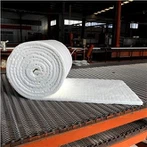


The principle of ceramic fiber blanket in fire resistance and insulation
a. Poor heat transfer ability of ceramic fibers: the ceramic fiber blanket does not have a clear direction when it is interwoven, and the heat is generally transferred along the fiber when it is transferred. Such non-directionality makes the heat unable to transfer quickly. In addition, when the ceramic fiber blanket is in contact with the hot surface, it is rarely in vertical contact, which makes it difficult for the heat to be transferred to the fiber. In addition, the contact points of the fibers can reach 80%, which further expands the thermal resistance of heat transfer. The ceramic fiber itself is opaque, heat rays cannot be transmitted in the fiber, and the area of the fiber is small, and the radiation received is less, so the heat radiation will basically not be transmitted on the fiber.
b. There is too much gas inside the fiber, and the convective heat transfer is poor: when the fibers are intertwined, many air chambers are formed, and these air chambers are filled with still air. We all know that air has a poor ability to transfer heat, let alone still air. On the one hand, these static gases have poor heat transfer effect, and on the other hand, they can hinder the intrusion of hot gas flow.
Why are ceramic fiber blankets are not water resistant?
Although the ceramic fiber blanket has a small water absorption capacity, due to its very large specific surface area, it is very important to control the relative humidity of the workshop. Special attention must be paid to rainproof measures during storage and transportation. The friction of fibers with other solid materials in textile processing will generate static electricity, and the electrostatic phenomenon generated by ceramic fiber blankets is more prominent than that of natural fibers and organic fibers.
The main reason for ceramic fiber blankets is determined by its own structure. Ceramic fiber acupuncture blankets are all fibrous processing. There are many pores between the fibers filled with air, and the thermal conductivity of the air itself is very low. Therefore, for ceramic fiber blankets It is said that a good thermal insulation effect is formed. If there is water entering the pores, the thermal conductivity of the water itself is high and the thermal conductivity is fast, so the thermal insulation effect of the ceramic fiber blanket will be greatly reduced.