

Explanation of the concept of thermal expansion and contraction
Thermal expansion and contraction refers to the property that an object expands when heated and contracts when cooled. Since the motion of particles (atoms) in an object changes with temperature, when the temperature rises, the vibration amplitude of the particles increases, causing the object to expand; but when the temperature drops, the vibration amplitude of the particles decreases, causing the object to shrink.
01 Ceramic fiber does not expand when heated
Many objects in nature have the properties of thermal expansion and contraction, but ceramic fibers will not expand after being heated, but also have a shrinkage rate of 0.03. The reason is derived from the structural characteristics of the ceramic fiber itself.
The microstructure of ceramic fiber is a mixed structure composed of solid fiber and air, and its microstructure is characterized in that both solid phase and gas phase exist in the form of continuous phase. In this structure, the solid matter exists in the form of fibers with a diameter of 2~5um and a length of 30~250mm, and constitutes a continuous solid skeleton, while the gas phase exists continuously in the skeleton gap of the fiber material, and the porosity is greater than 90 %.
Therefore, the expansion of the ceramic fiber after heating will be folded by its own pores, and it will not be too obvious. This is the reason why ceramic fiber products do not expand when heated.
02 Anti-shrinkage of ceramic fiber when works in high temperature
In the application process of ceramic fiber products in high temperature furnace, due to the long-term high temperature environment, the fiber filaments composed of solid skeleton are broken due to dead weight or brittleness, resulting in skeleton collapse, fiber filaments aggregation, and reduced void space. Therefore, from the appearance of ceramic fiber products, there will be a certain shrinkage, shrinkage rate is generally less than 0.03.
Application advice
a. The selection of ceramic fibers should follow the principle of high refractory temperature, and reduce the linear shrinkage of ceramic fibers as much as possible;
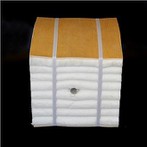
b. The ceramic fiber blanket block structure should be squeezed and compacted as much as possible during the construction process to prevent high temperature shrinkage from causing gaps in the furnace lining and damage to the furnace body;
c. When choosing ceramic fiber module furnace lining, it is recommended to have a certain amount of ceramic fiber cotton blankets for filling gaps in the later stage.