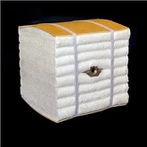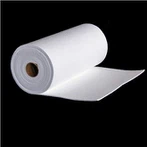


Ceramic fiber module is a block product in which the fiber blanket is cut (or bent) and then compressed. By compressing the laminated fiber blanket to increase its density, the extreme temperature during use is increased.
After the folded blankets are unbundled, they will squeeze each other in different directions without creating gaps; the elastic fiber blankets can resist mechanical external forces; the elasticity of the fiber blankets can compensate for the deformation of the furnace shell, so that there is no gap between the modules; due to the weight Lightweight, absorbs little heat when used as a thermal insulation material; low thermal conductivity brings high energy savings; Modules have the ability to resist any thermal shock; lining does not require drying and maintenance, so it can be put into use immediately after installation; anchoring system keeps the metal anchors at relatively low temperatures away from the hot side of the module.
The large-scale use of ceramic fiber modules has promoted the progress of kiln technology. It is a new type of refractory lining product introduced to simplify and speed up kiln construction and improve the integrity of the lining. It has good refractory insulation effect, improves the integrity of kiln refractory insulation, and promotes the progress of kiln masonry technology. Ceramic fiber module can be directly used as a flame heating surface, which integrates fire resistance, heat insulation, heat preservation and energy saving. It can still maintain good strength and toughness after long-term use in neutral, oxidizing and partial reducing atmospheres.
Energy-saving effect of ceramic fiber modules on industrial furnaces
Ceramic fiber module is a versatile high temperature insulator. Due to its wide applicability, it is used in thermal equipment in various industries. Compared with traditional thermal insulation materials, ceramic fiber modules have irreplaceable technical and economic advantages.
The application of ceramic fiber modules to industrial furnace insulation can effectively reduce the heat dissipation loss of the furnace wall. For the continuous operation of the industrial furnace, the heat storage is one-time, and the heat loss of the furnace wall is mainly the heat dissipation loss, so the thickness of the furnace wall can be appropriately increased to reduce the temperature outside the furnace wall; while for the gap furnace, the furnace wall is heated every time. During operation, a large amount of heat is absorbed, and the heat storage loss is greater than the heat dissipation loss. Therefore, light refractory materials with lower thermal conductivity can be used, or the thickness of the furnace wall can be reduced to reduce the heat loss of the furnace wall.