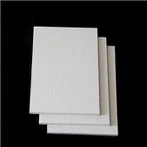


Ceramic fiber blankets are also known as aluminum silicate fiber blankets, because one of the main components is alumina, and alumina is the main component of porcelain. Ceramic fiber blankets are mainly divided into ceramic fiber blowing blankets and ceramic fiber spinning blankets. Ceramic fiber spinning blankets are better than ceramic red-dimensional blowing blankets in thermal insulation performance due to long fibers and small thermal conductivity. Most of the thermal insulation pipeline construction uses ceramic fiber spinning.
Ceramic fiber blanket is a continuous noil laying fiber blanket with higher tensile strength and flat surface after double-sided needle punching process. The fiber blanket does not contain organic binders, and ceramic fiber blanket has good chemical resistance (except for hydrofluoric acid, phosphoric acid and strong alkalis such as Na2O, K2O).
The performance of ceramic fiber blankets is not affected by oil and water. After drying, its thermal properties and physical properties are restored.
Insulation properties of ceramic fiber blankets
01 Insulation resistance and temperature
Ceramic fiber blanket has excellent electrical insulation properties and is an insulating material. The insulation resistance of ceramic fiber blankets decreases with increasing temperature.
02 Dielectric properties of ceramic fiber blankets
Under high temperature conditions, ceramic fibers still have high dielectric constant and low dielectric loss, and are suitable for use as high-frequency insulating materials.
03 Ceramic fiber blanket and breakdown voltage
Ceramic fiber blankets have higher breakdown voltage.