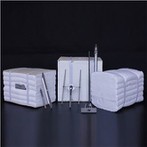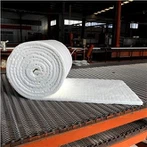


Ceramic fiber blankets have good sound absorption properties for high frequencies in the sound.
The main factors affecting the sound absorption performance of ceramic fiber blankets are thickness, density and airflow resistance. Density is the weight of material per cubic meter. Air flow resistance is the ratio of air pressure to air flow rate across a unit thickness of material. Airflow resistance is the most important factor affecting the sound absorption performance of ceramic fiber blankets. If the flow resistance is too small, it means that the material is sparse, the air vibration is easy to pass through, and the sound absorption performance is reduced; if the flow resistance is too large, it means that the material is dense, the air vibration is difficult to introduce, and the sound absorption performance is also reduced. For centrifugal glass wool, the sound absorption properties have the best flow resistance.
In practical engineering, airflow resistance is difficult to measure, but it can be roughly estimated and controlled by thickness and bulk density.
As the thickness increases, the sound absorption coefficient increases significantly in the mid- and low-frequency regions, but does not change much in the high-frequency regions (high-frequency absorption is always large).
When the thickness is unchanged, the bulk density increases, and the sound absorption coefficient of the medium and low frequency also increases; but when the bulk density increases to a certain extent, the material becomes dense, the flow resistance is greater than the optimal flow resistance, and the sound absorption coefficient decreases. For a ceramic fiber blanket with a bulk density of more than 5cm and a bulk density of 16kg/m3, the low frequency 125Hz is about 0.2, and the sound absorption coefficient of the medium and high frequency (>500Hz) is close to one.
When the thickness continues to increase from 5cm, the sound absorption coefficient of low frequency gradually increases. When the thickness exceeds 1m, the sound absorption coefficient of low frequency 125Hz will also be close to 1.
When the thickness remains unchanged and the bulk density increases, the low-frequency sound absorption coefficient of the ceramic fiber blanket will continue to increase. When the bulk density is close to 110kg/m3, the sound absorption performance reaches the maximum value, the thickness is 50mm, and the frequency is close to 0.6-0.7 at 125Hz.
When the bulk density exceeds 120kg/m3, the sound absorption performance declines, because the material becomes denser, and the sound absorption performance of medium and high frequency is greatly affected. When the bulk density exceeds 300kg/m3, the sound absorption performance is greatly reduced.
The thickness of sound-absorbing ceramic fiber blankets commonly used in architectural acoustics is 2.5cm, 5cm, and 10cm, and the bulk density is 16, 24, 32, 48, 80, 96, and 112kg/m3. Typically 5 cm thick, 12-48 kg/m3 ceramic fiber blankets are used.
The sound absorption performance of the ceramic fiber blanket is also closely related to the installation conditions. When there is an air layer behind the ceramic fiber blanket, the sound absorption effect of the ceramic fiber blanket with the same thickness and no air layer is similar.
In particular, the sound absorption performance of medium and low frequency is much higher than that of hard bottom materials, and the sound absorption coefficient will increase with the increase of the thickness of the air layer, but the effect is not significantly increased to a certain value.