

When constructing multiple layers of fiber mat or unlined lining, the layers must be in close contact. During the construction of the furnace top fiber blanket, in order to prevent the fiber blanket from falling off, clamps are used to temporarily fix it, and the fiber blanket layer is quickly compressed.
After the ceramic fiber blanket is fixed with bolts, nuts or locks, the surface is protected and the anchors will not be exposed in the high-temperature furnace. Especially in corrosive atmospheres, anchor points must be protected.
Regardless of the construction of the refractory fiber blanket on the furnace wall, furnace roof, furnace door, flue, or two or more joints, care must be taken to prevent the refractory fiber blanket from being squeezed out. When slag wool is used for furnace walls, the refractory fiber blanket must be isolated from the high temperature zone.
The structure of stacked refractory fiber blankets is fixed by needling. The refractory fiber blanket is cut into rectangular fiber strips with the same width as the furnace wall and fixed with pins of heat-resistant steel.
After fixing with pins, place the compressed refractory ceramic fiber blanket on the upper support plate and insert the pins into the fiber strips to prevent tilting or leakage.
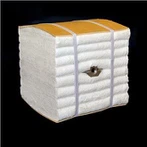
Formwork fixing is another form of lamination, which folds and compresses refractory ceramic fiber blankets into modules. There are two ways to repair the module. One method is to weld the formed modules to the furnace shell, and use bolts to insert and fix the refractory fiber modules to the furnace shell.
Another method is to glue and fix it. Cut the refractory ceramic fiber felt into a rectangle, fold it, and stick it on the lining with adhesive. When pasting, apply adhesive on the optical fiber module and press it with a wooden trowel to make it firmly bonded. Do not press on refractory fiber modules that are stuck during stamping. This method is widely used in construction.