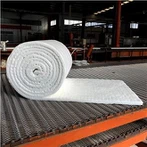


Ceramic fiber, white in color, odorless, light in weight, interwoven by needle-like fibers, sticky to the touch, stable in shape, and high in refractoriness. It is an essential product for high-temperature industrial kiln insulation.
Ceramic fiber is not a household item, so many people have no idea where to start when they need it. So how should ceramic fibers be selected? Let me show you guys a little bit of thinking.
01 Start from your own needs.
Ceramic fiber has good properties of fire resistance, heat preservation, heat insulation and sound absorption. First of all, it must have a clear direction. For example, low-grade ceramic fiber blankets or fiber cotton can be selected for heat preservation and sound absorption; for fire resistance and heat insulation, fiberboards and modules of corresponding grades must be selected according to the working temperature of the application environment; and ceramic fiber textiles can be selected for high temperature protection, fire prevention and other derivative products.
02 Combined with the application environment.
Generally speaking, a high-temperature furnace with a large and regular space generally adopts a ceramic fiber module + blanket combination structure, and there is a ceramic fiber fire baffle in contact with the open flame. When the space is irregular, flexible ceramic fiber blankets and fiber cloths can come in handy. The gap is filled with ceramic fiber cotton, and the burner and heating wire furnace can be customized with ceramic fiber special-shaped parts.
03 The refractory temperature is the basic basis for the selection of ceramic fibers.
According to the temperature, ceramic fiber products can be divided into five grades: ordinary (1050°C), standard (1100°C), high purity (1200°C), high aluminum (1200°C), and zirconium (1350°C) , in a word, it is right to adhere to the principle of choosing high and low materials.
04 Whether the color is pure white is an unwritten standard for judging the quality of ceramic fibers.
There is some truth to the saying that "the whiter the color, the better the quality" in this kiln circle. Generally speaking, the higher the alumina purity and the less impurities in the ceramic fiber, the whiter the color. Compared with the standard type and above fiber blankets, ordinary ceramic fiber blankets are dark yellow, and the higher the grade, the whiter the color.
05 The content of slag balls is an important indicator for judging the quality of ceramic fibers.
The slag ball is the crystal-like tiny slag ball contained in the ceramic fiber. It is a crystal produced by incomplete fiberization. Too much slag ball content will increase the thermal conductivity of the ceramic fiber and reduce the thermal insulation performance. Therefore, the less slag ball content, the better the product quality.
06 Chinese medicine pays attention to seeing, hearing, asking, and cutting, and it is also applicable to ceramic fiber products.
Ceramic fiber blankets are divided into two types: blowing and spinning. At first glance, compared with the toughness of spinning fibers, blowing fibers appear softer. It is more intuitive to touch by hand, the spinning fiber is slightly tangled, and the blowing fiber is slightly soft. This is because the spinning fibers are thick and long, and the blowing fibers are slightly shorter. There is nothing better to say about the two fibers, which can meet different application needs. Spinning fibers are mostly used to process into ceramic fiber blankets and ceramic fiber modules, while blown fibers are the substrates of ceramic fiber boards and ceramic fiber papers.
07 For cost-effective products, choose professional manufacturers.
There is a popular saying on the Internet that there is nothing wrong with expensive things except that they are expensive, and cheap things are all faults except that they are cheap. Remind friends not to lose the big because of the small. Of course, there are also high-quality and low-cost ones. For example, SUNTHERM is a professional manufacturer of ceramic fibers, providing one-stop service for production, design, construction, and after-sales, so that you can buy with peace of mind, use comfortably, and rest assured of quality.