
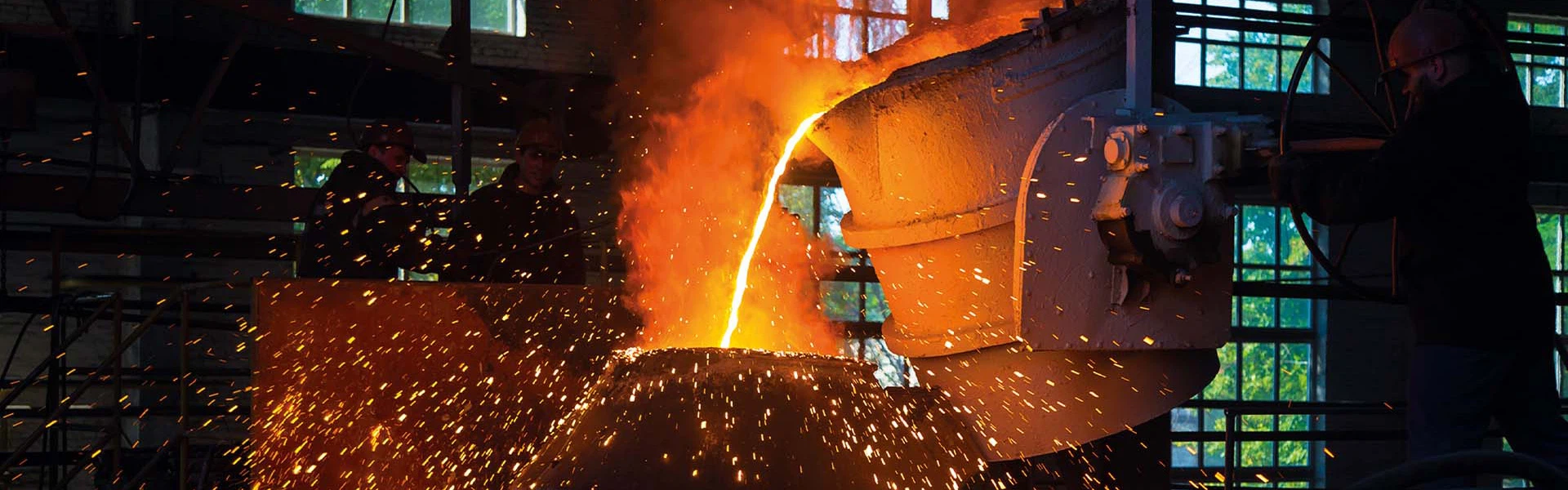


At the heart of high-temperature industries such as steel smelting, petroleum cracking, and ceramic firing, flames reaching thousands of degrees Celsius rage continuously. How can such tremendous heat be confined within the furnace chamber to ensure smooth production while preventing energy loss and overheating of the surrounding environment? The answer lies in a seemingly lightweight material-ceramic fiber modules. Recently, we took a closer look at the internal heat transfer mechanisms of this "insulation expert" to uncover the science behind its outstanding energy efficiency.
A Complex Battle of Heat Transfer
Many people assume that furnace insulation works like a solid wall that simply blocks heat. However, at the microscopic level, it is actually a complex battle of heat transfer mechanisms. Inside the lining made of ceramic fiber modules, heat transfer does not occur through a single mode.
According to experts, heat initially strikes the inner surface of the furnace wall-perpendicular to the high-temperature zone-primarily through convection and radiation. This represents the first wave of thermal attack. However, as heat penetrates deeper into the furnace lining, the temperature gradually decreases, and the intensity of convection and radiation rapidly diminishes. At this stage, the dominant heat transfer mechanism shifts fundamentally to thermal conduction.
This is precisely where ceramic fiber modules demonstrate their greatest advantage. Their extremely low thermal conductivity and heat storage capacity are mainly due to their very high porosity. As is well known, air and most gases have very low thermal conductivity. Ceramic fiber modules take advantage of this property by trapping heat within countless microscopic pores, making it extremely difficult for heat to pass through the material.
The Art of Insulation: More Than Just Thickness
Does making furnace walls thicker automatically improve insulation performance? The answer is not that simple. True thermal insulation is a precise science focused on maximizing thermal resistance.
"The essence of insulation is to maximize resistance to heat flow," explains an industry technical expert. "This requires insulation materials to have low thermal conductivity, low heat transfer coefficients, and low radiative heat transfer coefficients-in other words, very high thermal resistance."
The level of thermal resistance depends on a complex system of factors, including:
Material structure: The interweaving pattern of fibers and the assembly method of modules directly affect heat transfer pathways.
Bulk density: If density is too low, radiative heat transfer may increase; if too high, solid-phase conduction increases. Therefore, there is an optimal density range.
Pore size and characteristics: Small, closed, and uniformly distributed pores form the most effective barriers to heat transfer.
Moisture content: Water is a good conductor of heat, and any moisture penetration can significantly reduce insulation performance.
Heat flow direction: The orientation of fibers (whether perpendicular or parallel to heat flow) significantly affects thermal conductivity.
Temperature: The thermal conductivity of materials changes with temperature, and high-temperature performance is the key indicator of insulation effectiveness.
Composite Furnace Walls: Customized Insulation Solutions
For these reasons, modern industrial furnace lining design is far more sophisticated than simply stacking materials. Engineers carefully select and combine ceramic fiber modules with different characteristics based on specific furnace conditions, such as operating temperature and atmospheric environment (oxidizing or reducing).
The inner layers closest to the high-temperature zone may need to provide both radiation resistance and erosion resistance, while the outer layers focus on further reducing heat conduction. This composite layer design concept allows materials to perform optimally at different temperature ranges, achieving an insulation effect where the combined performance exceeds that of individual layers.
It is also worth noting that in furnaces with special atmospheres (such as strongly reducing environments), the thermal conductivity of gases may change, thereby affecting the overall insulation performance of fiber modules. This places higher demands on the chemical stability of the materials.
Overall, ceramic fiber modules demonstrate that effective high-temperature insulation is not simply about material thickness, but about the intelligent combination of microstructure design, thermal physics, and engineering optimization-allowing them to serve as essential energy-saving materials in modern high-temperature industries.


