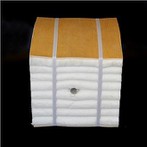
The reason why ceramic fiberboard is an inorganic material is mainly based on its composition and manufacturing process.
First of all, from the perspective of composition, ceramic fiberboard is mainly made of natural or artificial inorganic substances. Specifically, it contains inorganic components such as alumina and silica, which give ceramic fiberboard a series of excellent properties, such as high temperature resistance, corrosion resistance, and oxidation resistance. The presence of these inorganic components makes ceramic fiberboard an inorganic material in chemical nature.
Secondly, from the perspective of the manufacturing process, ceramic fiberboard is a plate made by mixing inorganic fibers (such as ceramic fiber wool) with specific refractory additives through a specific process and vacuum filtration molding. In this process, the mixing of inorganic fibers and refractory additives and the molding process are based on the characteristics and requirements of inorganic materials.
In summary, the reason why ceramic fiberboard is an inorganic material is that its composition is mainly composed of inorganic substances, and the manufacturing process is also based on the characteristics and requirements of inorganic materials. This makes ceramic fiberboard have excellent properties such as high temperature resistance and corrosion resistance, and has a wide range of applications in many fields.